

As students return to school, discussions about youth mental health will naturally focus on what happens when a young person is struggling: initial meetings with school-based health staff, family communication, school interventions, and if necessary, clinical referrals. Those supports matter, but a forthcoming study highlights the influence of the environment itself as an intervention.
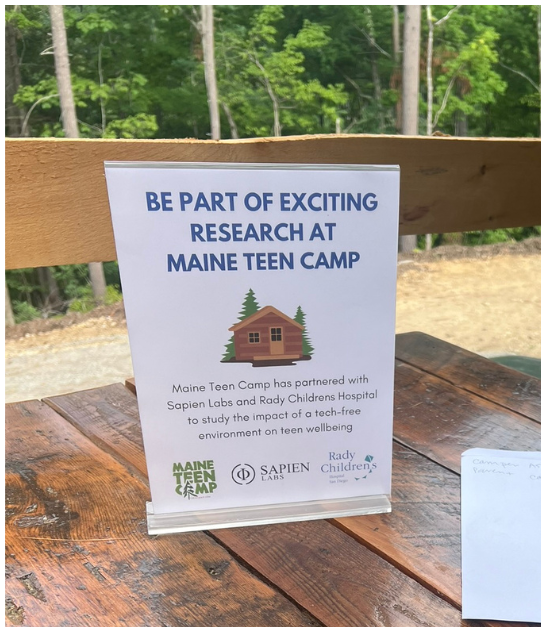
Researchers followed 192 teenagers attending a device-free residential summer camp for 2-3.5 weeks where they took Sapien Labs’ Mind Health Quotient before and after. The MHQ measures “mind health,” a construct related to, but broader than, clinical mental health. (Scores range from -100 to +200.) During that short period, average scores on Sapien Labs’ Mind Health Quotient (MHQ) improved by 10.1 points.
Teenagers who arrived at camp already struggling with their mind health improved the most, seeing a median improvement of 27 points. The largest gains appeared in adaptability and resilience, social functioning, and cognition categories. Teens also reported better focus, greater emotional resilience, less fear and worry, and less restlessness.
But remarkably, the clearest change was social.
Eighty percent of campers reported a strong sense of belonging at camp, compared with just 65 percent at school. That school number is not an outlier; it lands close to what national surveys of school connectedness find, which suggests the belonging gap is a feature of the setting rather than a quirk of this sample.
So, what happened at this camp? Devices were removed collectively. That word— collectively—may matter most. Individual screen-reduction efforts often produce modest or inconsistent results. One plausible reason is that a teen who cuts back still belongs to a peer network whose social life remains online. Camp changed the norm for everyone at once, so being offline carried no social cost. Campers spent their days talking face to face, moving, participating in shared activities, and being outdoors.
This study does have its limitations. It was not randomized and did not include a control group, so it cannot tell us with certainty which part of the camp experience was responsible for which gains. Camp bundled many ingredients at once—device removal, yes, but also outdoor time, physical activity, structured sleep, novelty, and freedom from grades—and the design cannot isolate any one of them. Additionally, the participating families chose—and could afford—a device-free camp, so the sample skews toward motivated, resourced households. Finally, camp is inherently designed for recreation, whereas school carries mandatory academic and evaluative pressures, so there is a question of whether a two-to-three-week change in behavior can be sustained over a 10-month school year.
But the findings sharpen a point that school-climate and ecological researchers have long argued: adolescent wellbeing is not fixed, and meaningful improvement does not have to begin with an individual clinical intervention. What this study adds is speed; measurable change in a few weeks, once the surrounding conditions changed. It also echoes earlier work, including a 2014 study in which five device-free days at an outdoor camp improved sixth graders’ reading of nonverbal emotion cues.
Mental health is also shaped by the conditions around a young person.
That has direct implications for schools and any organization that supports young people. Schedules, technology norms, opportunities for movement, access to healthy food options, peer relationships, adult attention, and the ease or difficulty of belonging all shape how young people function.
Schools can test whether some of the same conditions translate: more time for meaningful peer interaction, collective and consistent technology norms, more movement and outdoor activity, deliberate attention to whether students can make friends and feel that they belong.
This back-to-school season, the question is not just whether schools have enough school-based mental health staff. Most don’t, and environmental change is a complement to counseling and other human-based support, not a substitute for it; healthier conditions upstream mean fewer crises arriving at the school counselor’s door. It is also whether educational leaders are building school environments in which young people are more likely to feel connected, capable, and well.